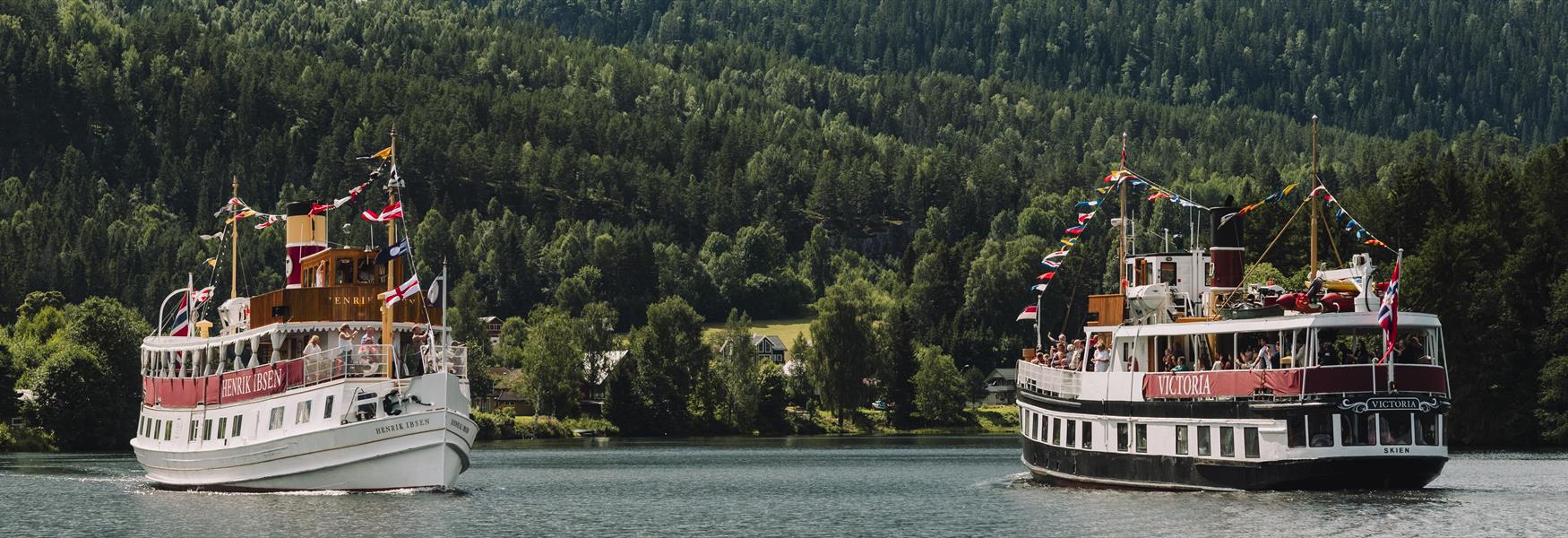




The Telemark Canal consists of two locks complexes. The Norsjø-Skien Canal, which was completed in 1861, is the first stage. The Bandak-Norsjø Canal, which was opened 31 years later, opens the connection between Norsjø and the Western Lakes to Dalen. The eight locks connect the sea to the inland.
The Norsjø-Skien Canal
The Norsjø-Skien Canal with locks at Skien and Løveid is the elder of the two Telemark canals, built between 1854 and 1861. The idea of canalizing the Telemark watercourse was introduced as early as 1805, when political economist Christen Pram entertained the notion that to be able to sail up the waterfalls Klostefossen and Skotfossen would be a most welcome convenience. In 1831, Governor F. Wedel Jarlsberg brought to the attention of the government the need for improved communications between Norsjø and Skien. The construction of a canal at Løveid was sanctioned in 1844. Plans for the construction were drawn up by the director of the project, Engebret Soot, his assistant Waligorski, and the two directors Røiem and Johan Tullin Thams.
The Bandak-Norsjø Canal, also called the Bandak Canal
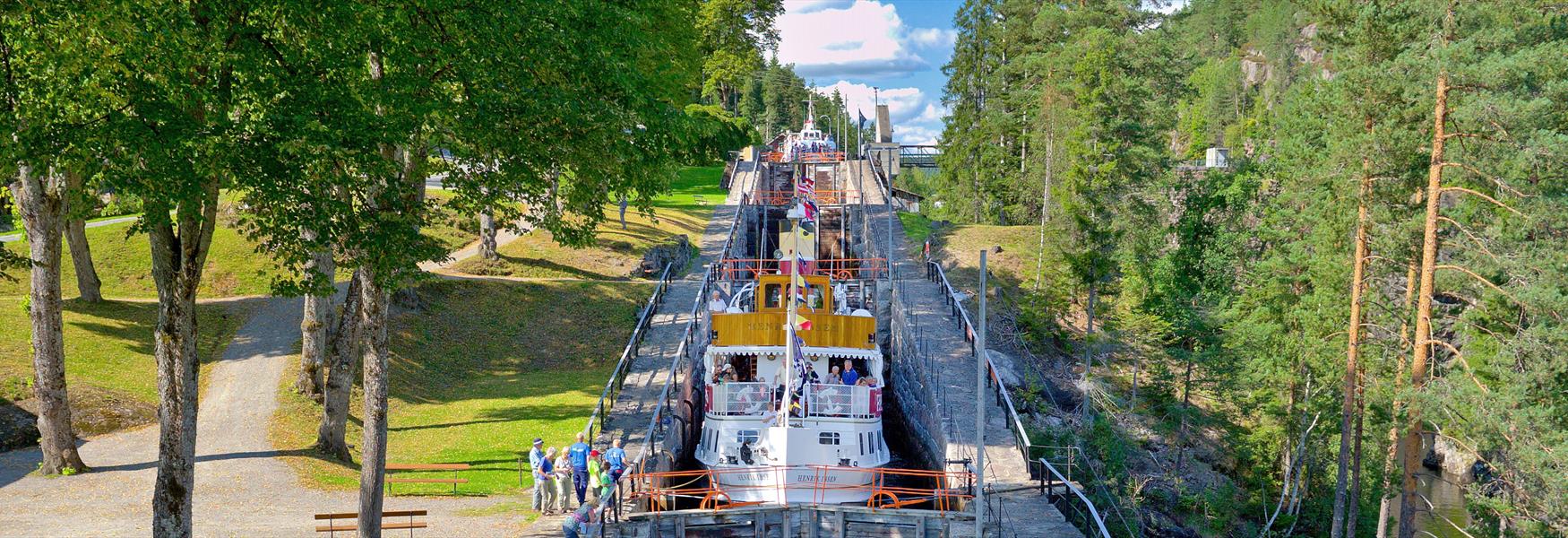
The Bandak-Norsjø Canal, also called the Bandak Canal was built between 1887 and 1892. The idea of building a canal between Ulefoss and Strengen was the brainchild of Axel Borchgrevink, manager of the Norsjø-Skien Canal, and Sætren, one of the directors. The motion was put before the Storting (Norwegian Parliament) in 1886 and construction commenced the year after. Fourteen locks were built along the 17 kilometres of canal between Ulefoss and Strengen, giving a total ascent of 57 metres (over 150 feet). The locks at Vrangfoss Falls are most impressive and, in the words of Teknisk Ugeblad (Technical Magazine) in 1892:
"a work of art which will bear perpetual witness to the skill of our engineers; it is this feat of engineering that will to the traveller be most fascinating and memorable".
The construction of the locks at Vrangfoss Falls and Hogga was both difficult and dangerous, but by June 1891, the canal was navigable by steamboat. The official opening took place on September 20, 1892.
The lock at Skien has one chambre and a lift of five metres. The bridge is from 1980. The tongue of land at Smieøya was the landing stage for the Telemark boats from 1860 to 1900, when the quay at Hjellen was built and taken into use.
The Løveid Canal and locks were built between 1854 and 1861. There are three locks, with a total lift of 10.3 metres. Deep holes were chiselled into the rock before it was mined with gunpowder.
The Telemark canal takes you fro the coast to the inland of Telemark - either to Dalen or to Notodden. The lower part of the canal consists of two lock systems; Skien and Løveid. These locks constitute a modern industrial canal, where everything is automated.
Here, you will find a list of telephone numbers that might be useful both prior to and after your visit to the canal.
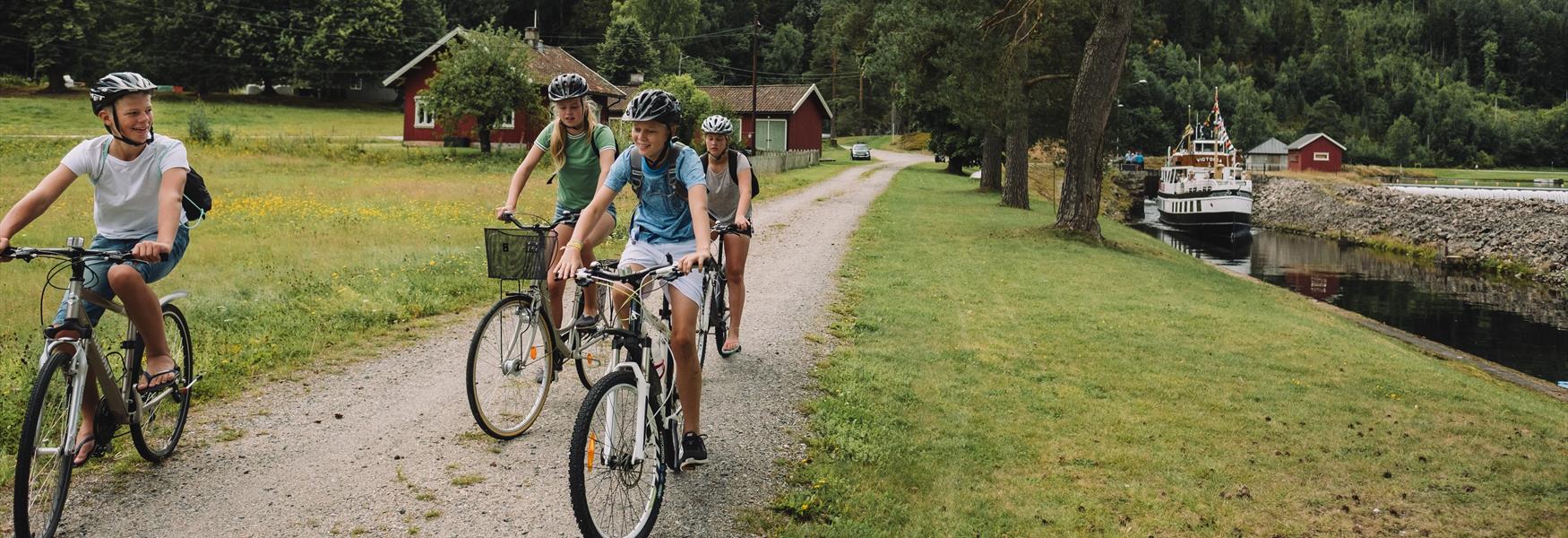
You don’t need your own boat in order to experience the Canal. The Canal can also by enjoyed from land. All the locks can be reached by car.
Nome Municipality is the result of a merger of the former municipalities of Holla and Lunde. The name Nome may have its origin in nauma (meaning narrow) from the root of the name for the River Nauma. Nomevatn, a reservoir lake, is located on the border between the two former municipalities. All the lock facilities in the Bandak Canal are located in Nome. The township hall is located in Ulefoss, although some administrative offices are located in Lunde. Manufacturing and construction are the most important industries here, employing about 1200 persons, approximately 50% of the total eligible workforce.
Vrangfoss is the largest lock complex on the Bandak Canal with five locks and a lift of 23 metres. Before canalization, Vrangfoss was about two kilometres long with a fall of 25 metres through a narrow rock passage flanked by high overhanging walls.
En route to Dalen, there are three major locks before you reach the mountain waters.