



Lunde, Kjeldal and Hogga

Lunde locks

Lunde locks

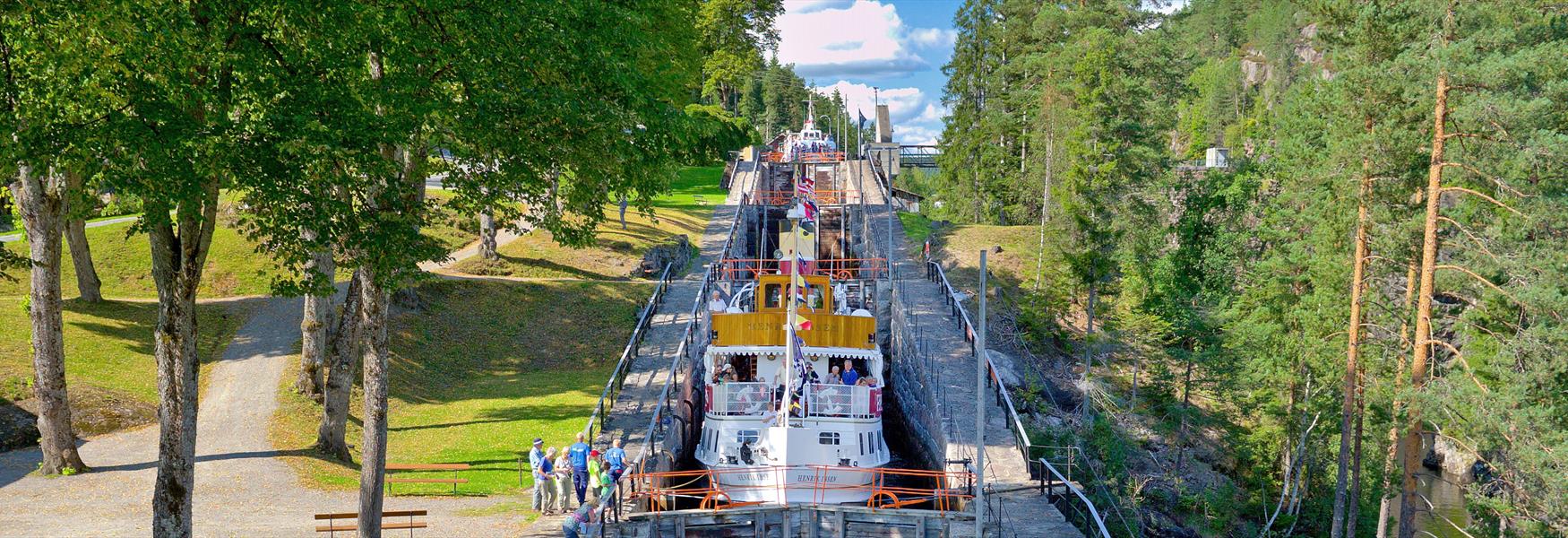
En route to Dalen, there are three major locks before you reach the mountain waters.

The lift of this lock is three metres. There is a quay for private boats. Part of an old needle dam has been preserved here, a typical example of the original dams used throughout the watercourse. Needle dams regulate openings for the water with wooden "needles", roughly 8 x 8 square cm. in diameter. The amount of water allowed to flow through the dam was regulated by raising or lowering these needles. In the larger needle dams, as at Hogga, which dammed up all of Vestvannene, there were also ground beams of about 13.5 sq. cm. to withstand heavy pressure. There were needle dams at Lunde, Kjeldal and Hogga. "Working with these dams, especially raising the ground beams, was risky business", wrote a man from Lunde who had been employed on these dams. "It was important to stay calm and keep your wits about you. The space between life and death was very narrow. You can imagine the force of the water rushing with tremendous speed just beneath you.»
The lock at Lunde is now the permanent home of the canal's old steam-powered dredging machine, Mudder’n, supposedly Norway’s oldest construction machine. It was restored by the Friends of the Telemark Canals.
The dam at Lunde lock is an air-filled "rubber sausage" mounted on a concrete foundation. By pumping more or less air into the "rubber sausage", its height is automatically adjusted to the amount of water in the river, making the water level constant above the dam. This construction has a number of advantages compared with steel hatches, e.g. lower construction costs, simpler operation, lower maintenance costs, and it is a better solution in terms of the environment and aesthetics. This type of dam is produced by a Japanese company. The dam at Lunde is one of the first of its kind in Europe.

Kjeldal lock
There is also a rubber dam at Kjeldal lock. The lock here has a lift of three metres. There is an old lock-keeper's house here as well. To the north there is a "needle house", a storage facility for the needles used in the dam which once stood here.

Hogga locks
Due to difficult ground conditions, Hogga was second only to Vrangfoss in terms of being a demanding construction site. Eight metres of loose soil had to be excavated by hand. The dam at Hogga holds back water from the west lakes Flåvatn, Kviteseidvatn and Bandak, a reservoir covering roughly 15 million square metres.
At Stormoen near Hogga, the river cuts through gravel deposited by glacial ice at the end of the Ice Age. Moen, with an elevation of 134 metres above sea level, is located at what was sea level during the Ice Age. The Hogga power plant was started in 1984, taking water from Straumane above Hogga dam. The power station is inside the mountain east of the river. The water, which flows through a tunnel several kilometres long, comes out below Lunde lock. The Lower Hogga Canal has beautiful stonework and a forested man-made island between the canal and the river. One of the oldest devices for maneuvering the lock gates can be seen at Hogga locks, a wrought iron cylinder with a crank that has a beautiful wrought iron rosette on top. This was the original mechanism on the locks in the Norsjø-Skien Canal opened in 1861. The lockkeeper’s residence is south of the locks.
Above Hogga, the water traveller sees the old road along the watercourse. This idyllic stretch of road, which was in bad condition, was restored by the Public Road Administration and Nome Municipality. The road was finished in time for the canal’s centenary in 1992.

eZ Publish™ copyright © 1999-2012 eZ Systems AS